What Are We Getting For It?
Connecticut charges more than almost any state in the country. The return on that investment is a polite way of saying: not much.

Let’s take inventory.
You pay the third-highest effective property tax rate in the nation. You pay a state income tax that climbs to 6.99% with a recapture provision that quietly eliminates the benefit of lower brackets. You pay 6.35% sales tax. You pay a 25-cent-per-gallon gas tax. You pay an annual property tax on your car — assessed every October, sent by your town, charged simply for owning a vehicle regardless of whether you drive it. You pay a gift tax that exists in no other state in the union. You pay a conveyance tax when you sell your home. You pay a probate fee when someone dies.
And then you open your electric bill.
Right there on the statement, below supply and delivery, is a line called “Public Benefits Charge” — a collection of state-mandated programs bundled into your utility bill rather than the state budget, where they might face scrutiny. As of 2025, Connecticut ratepayers are paying slightly more than $1 billion per year through this charge. It accounts for roughly 20% of the typical Eversource customer’s monthly bill. It is, functionally, a tax. It just doesn’t appear on your tax return.
There is also the ten-cent bottle deposit — technically a refundable fee, practically a tax on beverages that most people pay and few fully reclaim. There are permit fees for decks, pools, generators, and fences that vary by town across 169 separate municipal governments. There are recording fees, land transfer fees, business registration fees, and licensing fees layered on top of everything else.
Connecticut is not a low-tax state that charges a lot. It is a high-tax state that charges everywhere. Every transaction, every asset, every utility bill, every bottle of soda is an opportunity the state and its municipalities have not passed up.
Which raises a question the state’s political leaders prefer not to answer directly: for all of this, what exactly are Connecticut residents getting?
The Report Card
WalletHub’s 2026 taxpayer return-on-investment study offers one of the most direct answers available. It compares what residents pay in state and local taxes against the quality of government services they receive, using 29 metrics across education, health, safety, infrastructure, and economic performance.
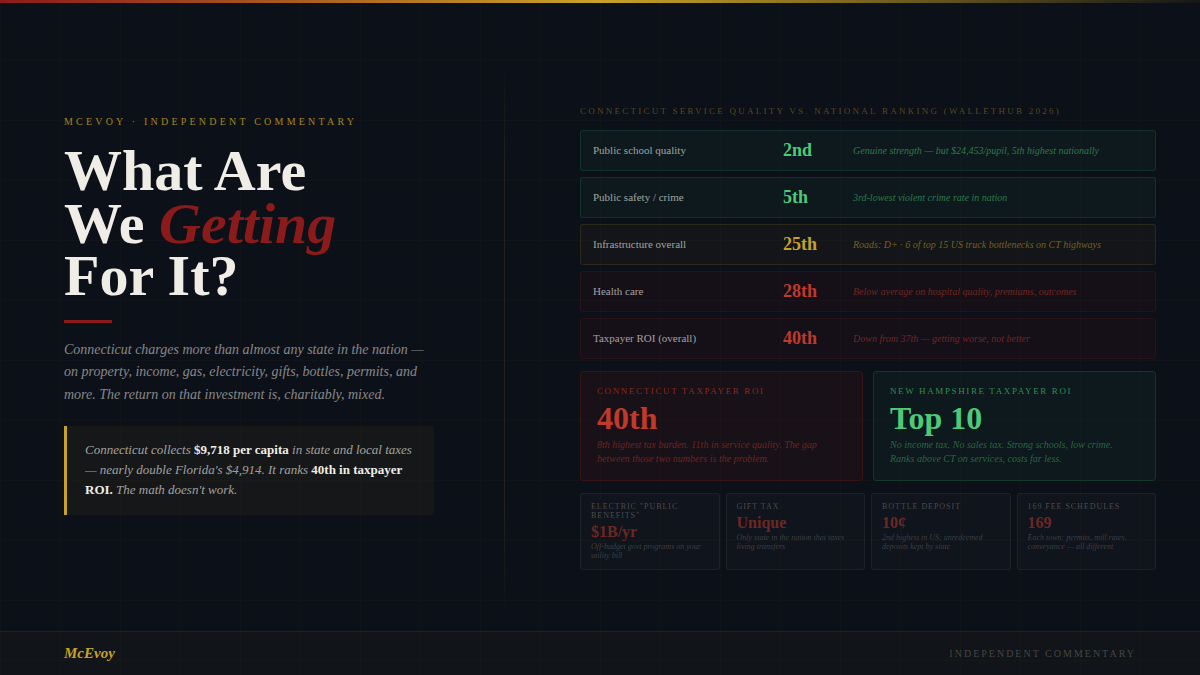
Connecticut ranks 40th in the nation for taxpayer ROI — down from 37th the previous year. The state has the 8th highest tax burden among adults, and ranks 11th for overall service quality. The math is straightforward: Connecticut charges near-top-dollar and delivers upper-middle-tier services. That imbalance drives the ranking, and it has been getting worse, not better.
Drill into the subcategories and the picture becomes clearer about what Connecticut does well — and where the money is not going.
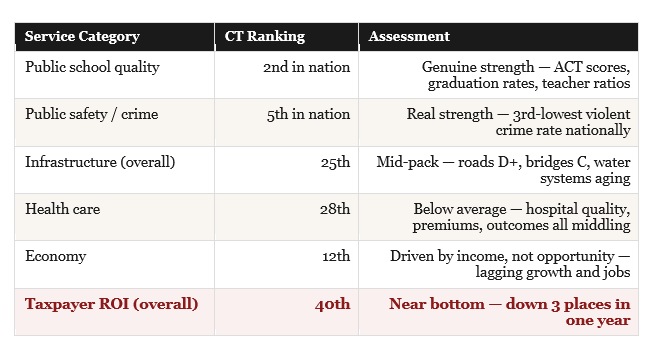
Connecticut’s schools are genuinely excellent. That is not spin — it is a documented fact, and one worth acknowledging honestly. ACT scores are the best in the country. Roughly 7.6% of public schools rank among the top 700 nationally. The pupil-to-teacher ratio is among the lowest five states. These are real achievements.
But here is what makes the school ranking complicated: Connecticut spends $24,453 per pupil — fifth highest in the nation. And enrollment has fallen 8.2% while staff grew 14.1%. Connecticut is achieving strong educational outcomes by spending extraordinary amounts of money. The question is not whether the outcomes are good. The question is whether $24,453 per pupil is necessary to achieve them, or whether it reflects a system optimized for employment rather than education.
Everywhere else on the ledger, the returns diminish quickly.
The Roads You’re Paying to Not Fix
Connecticut’s roads received a D+ from the American Society of Civil Engineers — the same grade given to the nation’s roads overall, which themselves are considered in poor-to-mediocre condition. Six of the top fifteen freight and trucking bottlenecks in the entire country are located on Connecticut highways. Sixty-eight percent of urban interstates in Connecticut face routine congestion — eighth highest in the nation.
The average bridge in Connecticut is 53 years old, compared to the national average of 44 years. Engineers estimate a $650 million per year gap between current bridge funding levels and long-term preservation needs. Without additional revenue, the percentage of bridges in poor condition is expected to climb back to 10% by 2032.
Connecticut’s gas tax is 25 cents per gallon — among the higher rates in the region. That tax exists specifically to fund road maintenance. The roads are a D+. The gap between what’s being collected and what’s being spent on actual infrastructure is not small, and it is not new.
Water infrastructure is similarly stressed. Most Connecticut water treatment facilities were built in the 1970s and 1980s. Leaking water mains contribute to losses of 15 to 20% of total water production — water that residents have already paid to have treated, disappearing into aging pipes before it reaches anyone’s tap. The system requires more than $4 billion in maintenance over a 20-year horizon. Current funding covers a fraction of that.
Six of the top fifteen trucking bottlenecks in the country are on Connecticut highways. The gas tax is 25 cents a gallon. The roads are a D+.
The Electric Bill That Is Also a Tax
The public benefits charge on your Eversource or United Illuminating bill deserves its own treatment because it is the most creative example of Connecticut’s talent for charging residents for government programs without calling it a tax.
The charge funds a collection of state-mandated programs: energy efficiency initiatives, renewable energy procurement contracts, assistance for low-income customers who can’t pay their bills, and — the largest single component — a long-term power purchase agreement with the Millstone Nuclear Power Station that locks Connecticut ratepayers into buying power from a single plant at a guaranteed price until 2029. In 2024, the combined public benefits charge reached nearly $1 billion per year across Eversource and United Illuminating customers.
In July 2024, PURA approved a rate increase that added roughly $48 per month to the average Eversource residential customer’s bill. The increase reflected not just current program costs but a backlog of charges that regulators had deferred over the previous two years, collected all at once. Customers who thought their bill might go up a few dollars saw it spike by 25 to 30% in a single month.
The design of the public benefits charge is instructive. Connecticut legislators have used the utility billing system as an off-budget mechanism to fund programs they prefer not to defend in the general budget process. As a UI spokesperson noted, the programs represent “legislatively mandated public benefits programs collected on customers’ electric bills instead of the State’s General Fund.” Translation: these are government spending decisions that arrive on your electric bill rather than in your tax return, where they would be visible and subject to the spending cap.
Connecticut already has some of the highest electricity rates in the nation. The public benefits charge, which now represents roughly 18 to 20% of a typical residential bill, is a significant contributor. It is not a market-driven cost. It is a policy cost. And it is a policy cost that residents pay whether they are aware of it or not.
The Fee Archipelago
Below the headline taxes lies a geography of fees that Connecticut has developed with considerable ingenuity. They are individually modest. Collectively they constitute a friction layer on nearly every activity that involves the state or its municipalities.
The ten-cent bottle deposit — among the highest in the country, up from five cents and increased in 2009 — applies to water, soda, juice, and other beverages. Retailers are required to accept returns, but the infrastructure for doing so is inconsistent, and a meaningful share of deposits are never redeemed. The state and distributors retain unredeemed deposits, which by some estimates run to tens of millions of dollars annually. It is a tax on the purchase of beverages dressed as an environmental incentive.
Building permits vary by town and by project but are among the more consistent sources of friction for Connecticut homeowners. Adding a deck, installing a generator, finishing a basement, replacing a roof, putting in a pool, cutting down a significant tree in certain jurisdictions — each triggers a permit process with a fee schedule determined by one of 169 municipal governments operating under 169 different frameworks. The administrative burden is real. The cumulative cost, across a homeowner’s years of ownership, is not trivial.
The probate court system charges percentage-based fees on estates that pass through it — not just on taxable estates, but on modest ones too. A house, a savings account, a retirement account: the total estate value determines the fee, regardless of whether any estate tax is owed. For middle-class families managing the affairs of deceased parents, these fees arrive at the worst possible moment.
Connecticut is also the only state in the country with its own gift tax — a levy on transfers of assets made while the donor is still alive. Every other state with an estate tax simply waits. Connecticut taxes generosity in real time. It generates relatively modest revenue. It generates significant departures among exactly the asset-rich, locally-rooted families the state most needs to retain.
Connecticut is the only state with a gift tax on living transfers. It generates modest revenue and significant departures. The policy makes no economic sense. It persists anyway.
The Honest Accounting
WalletHub’s ROI ranking puts Connecticut 40th. New Hampshire — which has no income tax and no sales tax — ranks higher on taxpayer return. Florida ranks higher. So does Tennessee. These states are not delivering worse services than Connecticut. They are delivering comparable or slightly lesser services at dramatically lower cost per resident.
Connecticut’s defenders will point to the schools, and they are right to. The schools are excellent. They are also expensive to the point that the cost cannot be fully explained by outcome quality alone. Connecticut’s defenders will point to public safety, and again they are right. Crime is genuinely low. These are real achievements that residents value and pay for.
But the honest answer to “what are we getting for it” is this: excellent schools at extraordinary cost, low crime, mediocre infrastructure, aging water systems, middle-of-the-pack healthcare, a utility system that uses your electric bill as an off-budget policy funding mechanism, and a fee structure that taxes you for selling your home, owning your car, giving money to your children, and buying a bottle of water.
Connecticut collects $9,718 per capita in state and local taxes — nearly double Florida’s $4,914 and dramatically above the national average. For that premium, residents receive services that rank, on a value-adjusted basis, in the bottom quarter of American states.
That is not the hallmark of a well-run state. It is the hallmark of a state that has never had to justify its cost because the residents paying it had enough wealth to absorb it — until, gradually and then suddenly, they didn’t. The ones who had options did the math. Many of them are gone.
The ones who remain are still paying. They just have fewer neighbors to split the bill with.
— McEvoy —
Sources: WalletHub “States with the Best & Worst Taxpayer ROI” (2026); Yankee Institute (March 2026); CT Mirror (“What to know about the public benefits charge,” May 2025; “CT ratepayers paying over $1 billion per year in public benefits charges,” 2025); Inside Investigator (“Unplugged: The $7 billion tax in your electric bill,” 2025); ASCE Connecticut Infrastructure Report Card (2022); Tax Foundation State Tax Competitiveness Index 2026; CT General Assembly OLR; CT Office of Policy & Management.