The Invisible Inventory
Connecticut has a housing affordability metric that ignores most of the affordable housing that actually exists. That’s not an oversight. It’s a design choice.

Consider a three-bedroom apartment in Torrington renting for $1,100 a month. It has no government subsidy. The landlord has not signed a 40-year deed restriction agreement with the state. The apartment has never appeared on the Department of Housing’s affordable housing appeals list. By every reasonable definition of the word, it is affordable housing — a working family can afford it without spending more than 30% of their income.
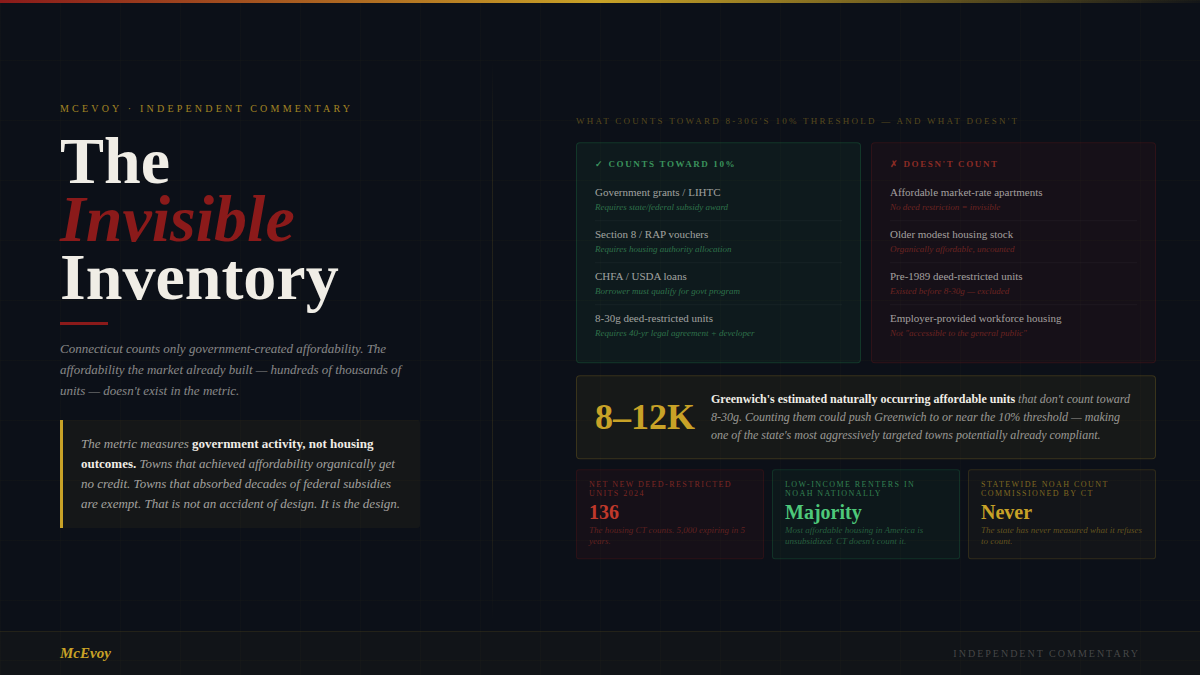
Connecticut’s 8-30g statute does not count it. It does not exist in the metric. It contributes nothing toward the town of Torrington’s 10% affordable housing threshold. The family living there is, in the state’s official accounting, living in market-rate housing that contributes to the shortage, not the solution.
This is not a minor technical footnote. It is the central methodological flaw in Connecticut’s entire approach to housing affordability — and it is a flaw the state has been aware of for years and chosen not to correct.
What NOAH Is and Why It Matters
Economists and housing researchers use the term NOAH — naturally occurring affordable housing — to describe housing that is affordable to low and moderate-income households without any government subsidy or deed restriction. NOAH is the older apartment building in a working-class neighborhood. The modest cape on a quiet street. The two-family house where the owner lives upstairs and rents the lower unit at whatever the market in that specific town will bear. The mill conversion that never got a tax credit.
Nationally, most low-income renters in the United States live in NOAH — unsubsidized housing that is simply priced below what higher-income renters pay, because of its age, its location, its condition, or the local market. The formal, subsidized affordable housing sector — the deed-restricted units, the Section 8 properties, the LIHTC developments — serves a critical population but represents a fraction of where working families actually live.
In Connecticut, NOAH is everywhere. It is the modest rental stock of Torrington, Ansonia, Derby, Putnam, and Willimantic — smaller cities and towns where market rents are naturally lower than the state’s affluent suburbs. It is the older multifamily stock in New Britain and Meriden. It is the housing that actual working families actually occupy, paying rents that actual working families can actually afford, without a subsidy, without a deed restriction, and without appearing anywhere in the state’s official accounting.
The Greenwich Example
Greenwich, Connecticut is one of the wealthiest municipalities in the United States. It is also, under 8-30g, one of the towns most aggressively targeted by affordable housing developers, because its official affordable housing percentage is low and developer projects there generate the highest market-rate revenue.
Here is what Greenwich’s own housing documents acknowledge: the town estimates it has between 8,000 and 12,000 naturally occurring affordable units that do not count toward its 8-30g percentage. These are apartments rented by working families — hospital workers, teachers, service employees — at rents below what higher-income residents pay, without any deed restriction or government subsidy. They are genuinely affordable. They house genuinely lower-income residents. They simply don’t count.
Why don’t they count? Because 8-30g’s definition of affordable housing requires that units be deed-restricted to income-qualified tenants for a minimum of 40 years. A landlord who rents to a nurse at $1,400 a month because that’s what the market supports in that neighborhood — that landlord has not signed a 40-year legal agreement guaranteeing continued affordability. The unit is affordable. It is not, in the state’s eyes, affordable housing.
Greenwich estimates that counting its NOAH inventory could push it to or near the 10% threshold — meaning one of the towns most aggressively targeted by 8-30g developers may already be functionally compliant with the law’s stated goal. It just doesn’t count by the rules the state has chosen to use.
The number: Greenwich estimates 8,000 to 12,000 naturally occurring affordable units that don’t count toward its 8-30g percentage. Tracking them would require reviewing thousands of lease documents annually. The state has never funded or required this accounting.
What the Metric Counts Instead
The 8-30g metric counts four categories of housing: government grants and LIHTC tax credits, housing vouchers, government-subsidized mortgages (CHFA and USDA loans), and deed-restricted units created by 8-30g projects. Every category requires either government subsidy or formal deed restriction. The metric is, by design, a measure of government-assisted housing — not a measure of housing affordability.
This distinction matters enormously. A town where rents are naturally low because the local economy produces moderate incomes and modest housing demand — a town that is genuinely affordable for the people who live there — receives no credit for that affordability unless it has received government grants, issued government-subsidized mortgages, or built government-subsidized deed-restricted units. Its naturally occurring affordability is invisible to the metric. The metric measures government activity, not housing outcomes.
It also means the metric has a structural bias toward government-dependent towns. The cities — Hartford, New Haven, Bridgeport — that have received the most federal public housing grants, the most Section 8 vouchers, the most LIHTC allocations are the cities that score highest on the 8-30g measure and are exempt from its enforcement. The towns that achieved affordability organically, through modest market rents and older housing stock, score lowest and face the most aggressive developer override pressure. The metric rewards dependency and penalizes self-sufficiency.
The 8-30g metric measures government activity, not housing outcomes. A town where rents are naturally low receives no credit. A city that has absorbed decades of federal subsidies is exempt. This is not an accident of design. It is the design.
The Deed Restriction Built to Expire
Even the affordable housing that 8-30g does count has a built-in obsolescence problem that the naturally occurring inventory does not.
Deed restrictions under 8-30g run for 40 years. A unit deed-restricted in 1995 expires in 2035. A unit restricted in 2005 expires in 2045. Connecticut is already losing deed-restricted affordable units to expiration faster than new ones are being added: 5,000 units are projected to expire statewide in the next five years against a net addition of 136 in 2024. The state is running a deficit on the housing it formally counts while ignoring the housing it doesn’t.
NOAH, by contrast, doesn’t expire. A modest apartment building in New Britain that has rented affordably for fifty years will continue renting affordably as long as the local market supports it. The affordability is organic and self-sustaining — it doesn’t require deed restriction renewal, government reauthorization, or developer participation to persist. It exists because the economics of that specific place produce that specific rent level. It is, in the most literal sense, the most durable form of affordable housing Connecticut has. And the state doesn’t count it.
What Counting NOAH Would Show
No comprehensive statewide NOAH count exists for Connecticut — which is itself an indictment of the state’s commitment to measuring actual affordability rather than subsidized affordability. But the available evidence suggests the numbers would be significant.
The CT169Strong analysis of the DOH’s own 2024 report explicitly flags the exclusion of naturally occurring affordable housing as a fundamental flaw in the methodology. The DOH’s own 2020 Connecticut Housing Assessment acknowledges NOAH’s existence and importance. Greenwich’s estimate of 8,000-12,000 unrecognized affordable units in a single, small town suggests that statewide, NOAH likely runs into the hundreds of thousands of units. If even half of those units were counted toward municipal percentages, the number of towns below the 10% threshold would drop significantly, the urgency of the “crisis” would be substantially diminished, and the legal basis for aggressive 8-30g enforcement in many currently non-exempt towns would be weakened.
The state has known this for years. It has not commissioned a comprehensive NOAH count. It has not funded the administrative infrastructure that would be required to track it. It has not proposed counting it in the 8-30g percentage. It has, instead, expanded the mandate — HB 8002, the Fair Share study, the housing growth plans — on the basis of a metric that deliberately excludes the majority of affordable housing that actually exists.
A Simple Reform
Counting NOAH toward the 8-30g percentage would require administrative work. Greenwich’s own estimate — 8,000 to 12,000 lease documents reviewed annually — illustrates the scale of the task for one town. Statewide, the burden would be significant.
But the burden is not insurmountable, and the state has demonstrated a willingness to impose substantial administrative burdens on municipalities in the name of housing compliance. The housing growth plans required by HB 8002 impose their own significant administrative costs on every Connecticut town by 2028. If the state can require 169 municipalities to file housing growth plans identifying specific development parcels, it can fund and require an annual survey of rent levels in the existing housing stock.
The reform is straightforward: define naturally occurring affordable housing as any unit occupied by a household earning below 80% of area median income, at a rent that does not exceed 30% of that household’s income, regardless of whether it receives government subsidy or carries a deed restriction. Count those units toward the 8-30g percentage. Commission a baseline count. Update it every five years, coinciding with the revaluation cycle towns already conduct.
This single change would transform the 8-30g metric from a measure of government housing activity into a measure of actual housing affordability. It would credit towns that have achieved affordability through organic market conditions. It would reduce the number of towns subject to developer override pressure based on a more honest accounting of what’s actually available. And it would force the state to confront an uncomfortable truth:
Connecticut may have far more affordable housing than it is counting. It has simply chosen a definition that excludes most of it — a definition that happens to keep the crisis number large, the developer opportunity open, and the advocacy funding flowing.
— McEvoy —
Sources: CT169Strong White Paper on DOH’s 2024 8-30g Report; CT DOH, “Connecticut Housing Assessment” (December 2020); Town of Greenwich, “Affordable Housing Units (CT Gen. Statute 8-30g)” (greenwichct.gov, 2025); Alvarez-Nissen, Vega & Beal, “40,000 Unsubsidized Affordable Homes at Risk” (California Housing Partnership, 2025); Colburn, Walter & Pfeiffer, “Capitalizing on Collapse” (Urban Affairs Review, 2021); National Low Income Housing Coalition, “Out of Reach 2024”; DataHaven, “New Census Data Product Maps 40,000 New Connecticut Homes Since 2020” (February 2026); CT Mirror, 8-30g coverage 2024-2025; ECOnorthwest Connecticut Fair Share Housing Needs Assessment (January 2025).