The Incredible Shrinking City
Connecticut’s cities housed far more people a century ago than they do today. The housing stock is gone because the government demolished it. Now the government declares a crisis

Hartford, Connecticut had 177,397 residents in 1950. Today it has 121,054. The city is 32% smaller than it was at its peak — a loss of more than 56,000 people in seven decades. The city limits haven’t moved. It’s the same 17.4 square miles.
New Haven peaked at 164,443 in 1950. It has 135,319 today. Bridgeport peaked at 158,709, also in 1950, and has 148,028 today. Waterbury, New Britain, New London — the same story, repeated across every industrial city in the state. Connecticut’s urban centers were built for a population significantly larger than the one currently living in them.

And yet: Connecticut’s housing advocates, state officials, and consulting firms paid $255,000 by the legislature are telling us we have a housing crisis. That the state needs between 110,000 and 380,000 new units. That the vacancy rate is dangerously low. That without urgent intervention — overriding local zoning, mandating density, forcing new construction statewide — Connecticut’s housing shortage will only worsen.
The question nobody is asking: if Connecticut’s cities once housed significantly more people than they do today, where did the housing go? And why, if it is gone, does the solution involve forcing new construction in suburban towns rather than in the cities that lost both their populations and their housing stock simultaneously?
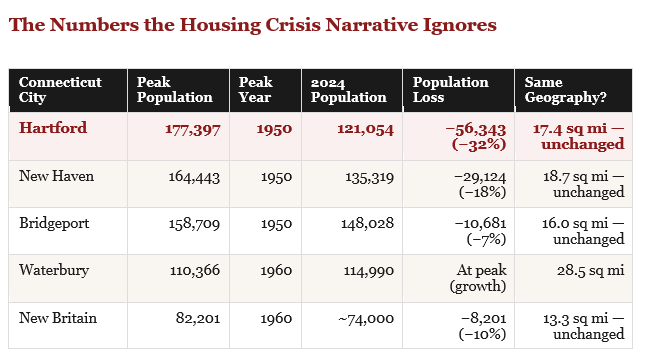
These are census figures — official, historical, undisputed. Hartford’s peak population of 177,397 was recorded in 1950. The same year, it was the 54th-largest city in the United States. Today it is the 244th-largest. New Haven was the 59th-largest city in America at its peak. It is now the 209th-largest.
The geography didn’t change. The city limits are the same. The land is the same. What changed is that tens of thousands of people left — and the housing that once accommodated them was largely demolished, allowed to decay, or converted to non-residential use. Connecticut is now being asked to build housing to replace the housing its cities spent fifty years destroying.
Hartford had 177,397 residents in 1950. It has 121,054 today. The city is 32% smaller than its peak. Connecticut’s housing advocates say we need 110,000 to 380,000 new units. Perhaps they should ask what happened to the ones that used to be there.
How the Housing Disappeared
The loss of housing in Connecticut’s cities was not accidental. It was policy — a series of deliberate decisions made by federal, state, and local governments between the 1950s and 1990s that systematically demolished urban neighborhoods in the name of renewal, highway construction, and slum clearance.
Interstate highway construction was the single largest driver of urban housing demolition in Connecticut. Interstate 84 was carved directly through Hartford’s residential neighborhoods in the 1960s, displacing thousands of households. Interstate 91 consumed additional land along the Connecticut River’s edge. Interstate 95 ran through Bridgeport, demolishing what the Wikipedia history of the city describes as “many homes throughout Bridgeport, including a largely Hungarian neighborhood in the city’s West End.” In New Haven, I-91 and I-95 required enormous right-of-way carve-outs through urban neighborhoods that had been densely populated for a century. The federal government paid 90% of highway construction costs. Local governments were left to manage the rubble.
Urban renewal programs compounded the damage. In Hartford, the Front Street neighborhood — a dense, walkable commercial and residential district — was razed to build Constitution Plaza, a modernist office complex that the city’s own history describes as “renowned and notorious.” New Haven pursued one of the most aggressive urban renewal programs in the country under Mayor Richard Lee in the 1950s and 1960s, displacing tens of thousands of residents and demolishing neighborhoods that had housed the city’s working-class population for generations. Bridgeport, Waterbury, and New Britain pursued similar programs with similar results: old housing destroyed, replacement housing frequently smaller in scale or never built at all.
White flight and subsequent abandonment completed the cycle. As middle-class families left for new suburban developments — enabled by the same interstate highway system and by FHA mortgage programs that explicitly favored suburban construction over urban rehabilitation — urban property values fell, tax revenues declined, services deteriorated, and the remaining housing stock was allowed to decay. Abandonment led to demolition. Demolition reduced housing supply. Reduced supply was never replaced because the economic conditions that made urban housing profitable had followed the residents to the suburbs.
The result, by the 1990s: Connecticut’s cities had significantly fewer housing units than they had in 1950, for a population that was already significantly smaller than 1950. The housing crisis of the post-pandemic era is, in part, the downstream consequence of fifty years of deliberate government-sponsored urban demolition.
The irony: The federal and state governments demolished urban neighborhoods with taxpayer money in the 1950s-1980s. Now state and federal governments are spending taxpayer money on a housing crisis attributable, in significant part, to that demolition. The solution being proposed involves building new units in suburban towns that had nothing to do with the original demolition.
The Vacancy Rate Paradox
Connecticut’s housing advocates cite the state’s 7% vacancy rate as evidence of a crisis — the lowest in the nation, far below the 11% national average. They are correct that the rate is low. They are not correct that the explanation is insufficient construction in suburbs like Wilton and Ridgefield.
The vacancy rate is low in Connecticut’s cities because the housing stock itself is low. Hartford has more than 3,300 units developed in the last eleven years with a 95% occupancy rate — meaning demand is there, but supply has not kept pace with even the modest population Hartford currently has. The city that once housed 177,000 people is running 95% occupancy for its 121,000 current residents. This is not a shortage of people relative to housing. It is a shortage of housing relative to the housing that used to exist. The crisis is real. Its causes are historical and governmental, not suburban and zoning-related.
The suburbs didn’t demolish Hartford’s housing. Interstate highway engineers and urban renewal planners did. Holding suburban towns accountable for replacing that housing through 8-30g and HB 8002 is not a housing policy. It is a displacement of responsibility.
If Connecticut’s housing crisis is concentrated in its cities — and the vacancy data says it is, with New Haven-Milford at 1.3% and Hartford metro at 2.9%, among the lowest rates in the entire country — then the policy response should be concentrated there as well. The question is not how to force Wilton to build apartments. The question is why Hartford, which once housed 177,000 people on 17.4 square miles, cannot house its current 121,000 in adequate density without a 95% occupancy crisis.
The Household Formation Counterargument
Housing advocates have a counterargument to the population decline data, and it deserves honest engagement: even if population is flat or declining, household formation can increase. As average household size shrinks — more singles, fewer multigenerational households, more one-person units — the number of households required to house a given population rises. Connecticut added approximately 78,000 more households between 2019 and 2024, even with modest overall population growth.
This is a real phenomenon. It is not, however, a phenomenon that explains why Connecticut needs 110,000 to 380,000 new units. The 78,000 household increase since 2019 is the relevant recent figure. The 380,000-unit housing need estimate encompasses far more than recent household formation — it includes a benchmark gap to the national vacancy rate average and an ambitious projection of future household formation that may or may not materialize as rates normalize and pandemic-era household arrangements reverse.
More fundamentally: if household formation is the driver, the solution is appropriately-sized housing units — studios and one-bedrooms for single-person households, two-bedrooms for smaller families — built near employment centers in the cities where demand is concentrated. This does not require overriding the zoning in Westport. It requires rehabilitating and rebuilding the housing stock in Hartford that was demolished between 1955 and 1990. That is a different policy, requiring different tools, different funding mechanisms, and a different honest accounting of why Connecticut’s urban housing stock is inadequate.
The housing crisis in Connecticut’s cities is real. Its cause is historical: fifty years of federally-funded demolition, urban renewal, and abandonment. The solution being proposed — overriding suburban zoning — addresses none of those causes.
What an Honest Housing Policy Looks Like
An honest housing policy for Connecticut would start with an honest accounting of what happened to the housing that used to exist.
Concentrate resources in cities, not extract them from suburbs. If Hartford’s vacancy rate is 2.9% and Wilton’s is perfectly adequate, the crisis is in Hartford. Build there. The Capital Region Development Authority has demonstrated that urban residential development works — 3,300 units at 95% occupancy in eleven years. Scale that up. Fund it directly. Stop using suburban towns as a pressure valve for a problem that is geographically located in the cities.
Acknowledge the federal highway debt. The interstate highway system demolished urban neighborhoods with 90% federal funding. The federal government has never reckoned with the housing consequences. Connecticut’s congressional delegation could make a compelling case for federal urban housing rehabilitation funding tied specifically to the highway-demolished neighborhoods of Hartford, New Haven, and Bridgeport. This is not a new idea. It is an idea that has never been pursued with the same political urgency as 8-30g enforcement.
Use adaptive reuse seriously. Hartford alone has significant vacant commercial and office space — the consequence of decades of corporate departure that we have documented elsewhere in this series. Converting underutilized office parks and commercial buildings to residential use is a faster, cheaper, and more targeted intervention than suburban upzoning. Several such conversions are underway. None are happening at the scale the vacancy rate warrants.
Stop conflating urban housing crisis with suburban housing politics. The 8-30g statute was designed to address suburban exclusionary zoning. It has produced 136 net new deed-restricted units in 2024 while 5,000 expire. HB 8002 mandates market-rate housing across the state without addressing the specific vacancy crisis in the cities. Neither law rebuilds what was demolished. Neither addresses the historical causes of the shortage. Both generate litigation, developer profit, and political conflict without producing the housing the crisis actually requires.
The Question Hartford Won’t Ask
In 1950, Hartford housed 177,397 people on 17.4 square miles. That is a density of roughly 10,200 people per square mile. Today Hartford has 121,054 people on the same land — a density of about 6,958 per square mile. The city is not fully utilizing the capacity it demonstrated it could house within living memory.
The housing is gone because the government demolished it. The population left because the government’s highway and renewal programs destroyed the neighborhoods that had made the city livable. The manufacturing economy that had supported that population followed its workers to the suburbs and eventually out of the state entirely.
None of this is Wilton’s fault. None of it is Ridgefield’s fault. The solution to a problem created by federal highway engineers and urban renewal planners in the 1950s and 1960s is not to override the zoning of suburban towns that had nothing to do with those decisions.
The solution is to rebuild what was lost — in the places it was lost — with honest acknowledgment of why it is gone and genuine resources directed at the geography where the crisis actually exists. A housing policy that ignores seventy years of urban demolition history and blames suburban zoning for the consequences is not a housing policy. It is a political argument wearing a housing policy’s clothing.
Connecticut’s cities were once thriving, dense, and significantly more populous than they are today. The people left. The housing was demolished. The government’s response, seventy years later, is to declare a crisis and force suburban towns to build new units. The cities that generated the crisis are exempt from the mandate. The suburbs that had nothing to do with it are the target.
That is not a plan to solve a housing shortage. That is a plan to build a political coalition on top of one.
— McEvoy —
Sources: U.S. Census Bureau decennial census data 1900-2020; BiggestUSCities.com population history; Wikipedia – Hartford, Connecticut; Wikipedia – History of Bridgeport, Connecticut; DataHaven, “New Census Data Product Maps 40,000 New Connecticut Homes Since 2020” (February 2026); CT Public Radio, “In Connecticut, rental vacancy rates are the lowest in the U.S.” (August 2022); iPropertyManagement, Rental Vacancy Rate Data (2025); MetroHartford Alliance, “Housing is Hartford’s Most Urgent Economic Growth Strategy” (March 2026); ECOnorthwest CT Fair Share Housing Needs Assessment (January 2025); CT Mirror, “CT housing market has 7% vacancy rate; tightest in U.S.” (January 2025); CT State Office of the Secretary of State, Population 1900-1960.